The Art Teacher ~ an Endangered Species?

I had a lot of fun snooping around a friend's high school art classroom.

Unfortunately many teachers who work in our public school systems are finding that the arts are no longer a top priority. 


Faced with dilemmas like how to raise test scores and how to stretch budgets as far as they can go ~  policy makers are increasingly looking to cut arts education in the schools. 


Trouble is, many hold the misconception that art is a superfluous, isolated subject when, in fact, nothing could be further from the truth.


My friend Deb is a High School Art Teacher and she says that teaching her students about art is an essential element in a well rounded education. 

I thought you might enjoy a stroll through her (very interesting) classroom via photographs.


It's been proven that early exposure to visual art, music, or drama promotes activity in the brain. Art helps children understand other subjects much more clearly - from math and science, to language arts and geography. 


Art nurtures inventiveness as it engages children in a process that aids in the development of self-esteem, self-discipline, cooperation, and self-motivation. 


Participating in art activities helps children gain the tools necessary for understanding human experience, adapting to and respecting others' ways of working and thinking, developing creative problem-solving skills, and communicating thoughts and ideas in a variety of different and unique ways.


Teaching children about art is not just about showing them how to recognize a Rembrandt or a Picasso.


Drawing can provide the basis for other creative activities - like painting, sculpture and printmaking - but it also provides a direct link with reading, writing and especially mathematics.


Art stimulates both sides of the brain.


Nearly one third of all children are visual learners.


There are studies that show that children who make art, read better and get better grades in science and mathematics.


Children learn by using their senses and art is ideal in this process


Children need a safe place to express themselves at school.


The creation of art promotes self esteem.


Art encourages children to be aware of - and give more attention to - the physical space that surrounds them.


 Art develops hand and eye coordination.


  Art stimulates perception. 


Art teaches a child to think openly. It represents a culture of questioners - more than a culture of responders. 


Art teaches that there is more than one solution to a problem. 


 Art teaches children to think creatively to solve problems. 


Children can share and reflect on their particular work of art and learn something about the world they live in.


When art is integrated with the other subjects in the curriculum, children commit more to the learning process.


In the process of doing art, the child is exposed to many different possibilities of discovery.


Art can help a child avoid falling into the predictability of an uncreative "conventional" education.


Art nourishes the human soul. 


One feels good making art.


Art can bring the cultural resources of the community into the classroom.


Art invites participation in many diverse activities ~ and children get a result to show for their efforts.


 Art provides a common ground across racial stereotypes, barriers and prejudices. 


Art is valuable all by itself.


I think art is essential for learning and helps children perform better in other areas of life and makes learning a more well-rounded experience. 


According to neuroscientists, the more a child’s brain is stimulated, the more intricate and complex become the neuronal connections.


This complexity translates into better memory perceptions and cognitive abilities which are all important for learning process.


Art teaches children to look at a phenomenon from different angles. This is an important strategy which scientists use in their discoveries.


It is also said that art is a great stress-buster. It is the involvement in a creative process, coupled with the release of emotion and diversion from the stress-or that makes art a good source of relaxation.


Deb's classroom is full of visual stimulation - everywhere you look.


She and her students have managed to grab just about every art- related cartoon they could find...and they posted them in some surtising places.


In Deb's classroom - art is about having fun as you learn and do the hard work of growing up.


Don’t we all take a break to have fun in life?


The feeling of well-being, a by product of fun, energizes us.


Deb keeps all sorts of materials available for her students.


Her classroom is packed with inspiration - everywhere you look.


Even the fire exit signs are creative and student made.


The Old Masters hang around in Deb's classroom.


I am not sure that it would be possible to become visually bored in this classroom.


These models "hold a pose" for a long time so Deb's students can learn to draw drapery.


There are individual eye-level still life areas set up around the room.


Still life material hangs from the ceiling....Deb doesn't waste space.


A good art teacher helps create good memories which carry into adult lives. 

Why Beauty Matters

(Despite the title, this is in English)

Rethinking the "ugly" in art...

Philosopher Roger Scruton presents a provocative essay on the importance of beauty in the arts and in our lives. 

In the 20th century, Scruton argues, art, architecture and music turned their backs on beauty ~ making a cult of ugliness and leading us into a "spiritual desert."

Using the thoughts of philosophers from Plato to Kant, and by talking to artists Michael Craig-Martin and Alexander Stoddart, Scruton analyses where art went wrong and presents his own impassioned case for restoring beauty to its traditional position at the center of our civilization.

Update


I'm still here.


I've become increasingly frustrated with the limitations of this blog format.

Long ago, I explored and rejected the idea of a video. The limitations of a paperback book and the high cost of the final product didn't appeal to me as a good way to teach and so I began this blog.

But then the technology changed (think iPad) so I am working on an eBook with step-by-step detailed photos and text. I can teach and illustrate the basic principles of painting Classical Realism in a very simple, clear and basic way. You don't even need an iPad as you can download the free Kindle app on your computer to read an eBook.


I have kept Einstein's quote near my easel since I began this blog.

It took a long time to devise one single lesson that contains every basic principle you need to know plus all the tips, tricks, techniques and methods I have learned over the years.

Painting is more simple than most people think. But it is currently "hard" for most people because hardly anyone knows - or teaches - the fundamental rules of how to paint classical realism so everyone from a beginner to advanced can "get it." 

The book I am working on will teach Classical Realism as a "craft to be mastered." I try to spell it all out and it doesn't require a huge talent or drawing skills - just some patience and hard work. 

But once you master the fundamentals of classical painting - then the art really begins.

So, nearly all of the actual step-by-step photos are done. About 65% of the text is written. And 80% of the specific detailed illustrations are finished.

When that is finished, I will have to edit the manuscript, make corrections, paginate and index this eBook. The cover ought to be a piece of cake.

Then I need to figure out how to upload the entire eBook to Amazon so it can be downloaded via their Kindle section.

It's a big job. I'm glad that I didn't know how big and complicated it would be before I began or I would have had second thoughts. My goal was to finish this fall....but that won't happen. So I just keep plodding along and will let you know when it is done.

Thanks for your patience.

Artist Recreates Flemish Paintings In Airplane Lavatory


Artist Nina Katchadourian has a creative way of passing the time on long-haul flights.


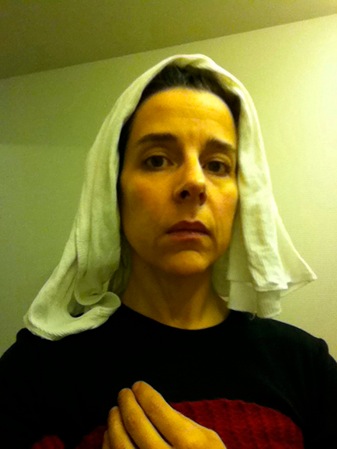
She recreates Old Master Flemish Paintings in a series she has dubbed "Lavatory Self-Portraits in the Flemish Style.”


She makes these photos while in flight - using only her cellphone- and the materials she finds around her.


In her own words:

"While in the lavatory on a domestic flight in March 2010, I spontaneously put a tissue paper toilet cover seat cover over my head and took a picture in the mirror. "


"The image evoked 15th-century Flemish portraiture. I decided to add more images made in this mode and planned to take advantage of a long-haul flight from San Francisco to Auckland, guessing that there were likely to be long periods of time when no one was using the lavatory on the 14-hour flight."


"I made several forays to the bathroom from my aisle seat, and by the time we landed I had a large group of new photographs entitled Lavatory Self-Portraits in the Flemish Style."


"I was wearing a thin black scarf that I sometimes hung up on the wall behind me to create the deep black ground that is typical of these portraits. "


"There is no special illumination in use other than the lavatory's own lights and all the images are shot hand-held with the camera phone."


This is Nina Katchadourian's website.


So, here's my point: "play" with your camera and your lighting. Use clothing and props in a unique and unusual way. Use these photos for inspiration...you have nothing to lose (except the boring old way of doing things).


Rules of thumb, #1 and #2:

"Clothes do not make the person - but they do make the portrait."

"Interesting clothing, props and lighting makes for an interesting portrait"


Any one of these would make a good reference photo for a painting.


A little imagination...


Lots of creativity...


By utilizing the materials at hand - not necessarily for their original function - but instead for a "look"...


Makes for some stunning and creative reference photos.


Too often I see portraits of people in "ordinary clothing"...but if you think "paintable clothing" - you'll end up with a better portrait.


By stretching her thinking beyond the ordinary, this artist created some very visually interesting and unusual photographs.


White is always a good way to "frame the face."


An interesting silhouette makes for an interesting portrait.


High contrast and definite shapes work in a portrait too.


All in all, I think that a great reference photo can be very simple - and very powerful.


And next time you're on an airplane and someone is hogging the bathroom...it could be an artist taking self portrait photos that look like an Old Master.

Or maybe not.

Artist Chuck Close's Letter to his Younger Self

"Inspiration is for amateurs,
the rest of us just show up and get to work."
- Chuck Close, Portrait Artist

No words left for me to say - this man just said it all.


He overcame his learning disabilities and his problem with face blindness - and used them to his best advantage - despite being "written off " at the age of fourteen.

Chuck now offers himself much better advice than he got.

My advice to my younger self would be:

"Go for it Karin! Don't listen to those fools - be an artist - don't worry, you can make a living."


Our First Lady on the Arts


“The arts are not just a nice thing to have or to do if there is free time or if one can afford it."

"Rather, paintings and poetry, music and fashion, design and dialogue, they all define who we are as a people and provide an account of our history for the next generation.”

- Michelle Obama