Artist Recreates Flemish Paintings In Airplane Lavatory


Artist Nina Katchadourian has a creative way of passing the time on long-haul flights.


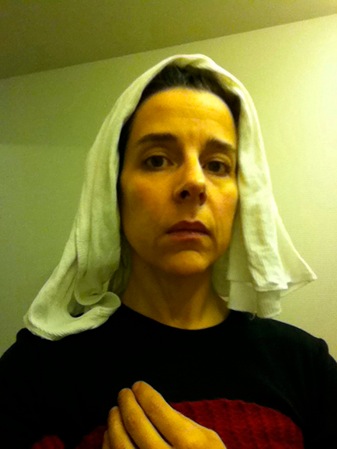
She recreates Old Master Flemish Paintings in a series she has dubbed "Lavatory Self-Portraits in the Flemish Style.”


She makes these photos while in flight - using only her cellphone- and the materials she finds around her.


In her own words:

"While in the lavatory on a domestic flight in March 2010, I spontaneously put a tissue paper toilet cover seat cover over my head and took a picture in the mirror. "


"The image evoked 15th-century Flemish portraiture. I decided to add more images made in this mode and planned to take advantage of a long-haul flight from San Francisco to Auckland, guessing that there were likely to be long periods of time when no one was using the lavatory on the 14-hour flight."


"I made several forays to the bathroom from my aisle seat, and by the time we landed I had a large group of new photographs entitled Lavatory Self-Portraits in the Flemish Style."


"I was wearing a thin black scarf that I sometimes hung up on the wall behind me to create the deep black ground that is typical of these portraits. "


"There is no special illumination in use other than the lavatory's own lights and all the images are shot hand-held with the camera phone."


This is Nina Katchadourian's website.


So, here's my point: "play" with your camera and your lighting. Use clothing and props in a unique and unusual way. Use these photos for inspiration...you have nothing to lose (except the boring old way of doing things).

Rules of thumb, #1 and #2:

"Clothes do not make the person - but they do make the portrait."

"Interesting clothing, props and lighting makes for an interesting portrait"


Any one of these would make a good reference photo for a painting.


A little imagination...


Lots of creativity...


By utilizing the materials at hand - not necessarily for their original function - but instead for a "look"...


Makes for some stunning and creative reference photos.


Too often I see portraits of people in "ordinary clothing"...but if you think "paintable clothing" - you'll end up with a better portrait.


By stretching her thinking beyond the ordinary, this artist created some very visually interesting and unusual photographs.


White is always a good way to "frame the face."


An interesting silhouette makes for an interesting portrait.


High contrast and definite shapes work in a portrait too.


All in all, I think that a great reference photo can be very simple - and very powerful.


And next time you're on an airplane and someone is hogging the bathroom...it could be an artist taking self portrait photos that look like an Old Master.

Or maybe not.

Artist Chuck Close's Letter to his Younger Self

"Inspiration is for amateurs,
the rest of us just show up and get to work."
- Chuck Close, Portrait Artist

No words left for me to say - this man just said it all.


He overcame his learning disabilities and his problem with face blindness - and used them to his best advantage - despite being "written off " at the age of fourteen.

Chuck now offers himself much better advice than he got.

My advice to my younger self would be:

"Go for it Karin! Don't listen to those fools - be an artist - don't worry, you can make a living."


Our First Lady on the Arts


“The arts are not just a nice thing to have or to do if there is free time or if one can afford it."

"Rather, paintings and poetry, music and fashion, design and dialogue, they all define who we are as a people and provide an account of our history for the next generation.”

- Michelle Obama

What About That "Magical Talent" Myth?


Malcolm Gladwell says it takes 10,000 hours of easel time to become "the best painter in the world."

10,000 Hours? Are You Kidding Me?


Here's my take on why it takes some time to become a good painter: it's the neurological training of your brain to a new task.

10,000 is a hard number to reach and most ordinary people bail long before reaching that goal (and presumably this is why most of us are not great painters).

Learning the craft of classical oil painting isn't easy if you're starting from scratch - but logging in whatever time it takes to become a competent painter really is doable for everyone.


You can learn to paint in an "intellectual" way - read this blog, pick up a brush and find out how "easy" it is - Ha!

But there is no substitute for putting in some serious time. Here's why "time" will teach your brain how to paint - and then painting will grow into an "easy" skill.

The repeated act of painting - over and over - builds a type of implicit memory - which means that your brain holds knowledge of something your mind cannot explicitly access. (i.e., you do it - but it is tough to explain).

Albert Einstein said: “Love is a better master than duty.” (In other words, it you love to paint it won't be hard to put in a lot of hours to learn this skill).

Riding a bike, tying your shoes, typing on a keyboard, and steering your car into a parking place are examples of what you learned by "doing it." And the more you do these things, the better, faster and more accurate you get.

But can you explain exactly how you do it? Not so easy...

By the act of painting repeatedly, you'll develop a perfectly timed choreography with which your muscles contract and relax as you navigate your way around a canvas with a loaded brush. The more you do it, the happier the result and the easier it gets.

ALBERT EINSTEIN:
“It is not that I'm so smart. But I stay with the questions much longer.”

This is the gap between what your brain can do and what you can tap into consciously.

The old studio system made it easier to learn to paint. The master would stand over the apprentice and watch and give feedback. After some period of time, the student's brain was trained to be masterful - albeit unconscious.

Sometimes this is assumed to be "talent" - but I think that merely putting in time counts for more than the "magical talent myth." In time, it actually becomes part of your neurology.

Good painters - and people on their way to being good painters - put in whatever hours are necessary - over some period of time - to learn the skill of good painting.

Einstein talks about time and repetition:
“If you want your children to be intelligent, read them fairy tales. If you want them to be more intelligent, read them more fairy tales.”

Handling paint is subtle. Oil paint "feels" different and behaves differently on different days. It depends on the temperature, humidity, how long it's been on the palette, the medium and canvas you're using, etc.

It takes time to learn these things and if you discover a substitute - please let me know.

If you painted 40 hours a week for a solid year you'd accumulate about 2000 hours. Thinking about 10,000 hours is a bit humbling, isn't it?

KARIN WELLS (trying to sound like Einstein):
“It is not that I'm such a good painter. But I probably worked more hours than most.”

The conscious mind is not at the center of the action in the brain; instead, it is far out on a distant edge, hearing but whispers of the activity.

You have to sit down and paint - repeatedly - if you want to become a good painter.

Grape Expectations: A Mini-Lesson in Massing Small (and Large) Objects


My friend Paul Pedersen* sent me a copy of his latest still life painting.


He was kind enough to allow me to stomp on his grapes as a way to teach you all a mini-lesson in correcting a common mistake.


I am grape-ful for Paul's nice little original still life above.

Paul has painted perfect little portraits of each grape - but he failed to "paint the bunch."


I photoshopped the painting to show how to "mass" this bunch of grapes together.

The bunch of grapes need to be painted as one entire unit - with both light and shadow as shown above.

In painting "reality" you paint the desired illusion (not merely what you see). In this case the "illusion" is meant to be "a bunch of grapes" - and not just sixty eight individual portraits of similar grapes (even though that is what they really are).

On the overall mass of grapes, the part nearest the source of light are the lightest - and the portion farthest from the light turns into shadow.

Massing small objects will always strengthen a painting.


Here is Paul's picture - photoshopped to show the result of massing. You can see that the overall light and shadow are maintained.

In painting the individual objects (in this case, grapes) you must not violate the light and shadow pattern you established underneath.

In other words, the values of each individual grape will completely respect the light and shadow you have established in massing the bunch.


Massing is so easy to see when you know what you're looking at. Chardin masses the bunch of strawberries in his still life.


Or when George Inness masses foliage in his landscapes...everybody does it - or they'd go nuts painting each tree branch and leaf.


Corot (and every other master painter I can think of) masses objects . . . trees and even those buildings in the distance.


Titian masses hair and fur in this portrait. Just imagine how impossible it would be to paint individual hairs?


Raphael masses hair and landscape elements.


Raphael masses hair and fur. You can see massing is everywhere - go to any good art museum and look at the Old Masters.

*NOTE: I trust Paul will forgive me for "raisin a fuss" about those grapes. (Groan - I ust cannot seem to help myself with those puns).


My eBook Update


In case you're wondering where I went - the answer is "nowhere." I am busy writing a book on "The Nuts and Bolts of Classical Oil Painting."**

My focus: Painting is a Craft that you need to master - before you get to the "art" part.

My aim is to write a basic textbook for someone who doesn't know a darn thing . . . except that they wish to paint in a classical realistic manner.


So many of us are visual - and need to be shown, rather than told, "how to make it look real." (There are rules for this, you know).

The format of this blog maddingly does not allow me to go into the detail I wish. So I am writing/illustrating an ebook to teach classical realistic painting.

So far it's a technical nightmare - but I'll eventually figure it out.

Stay tuned.

** This is only a working title, suggestions welcome.


Obvious Advice (for the Oblivious)


I keep this painting around the studio to remind myself that some lessons are really painful.


This is a detail of an oil sketch I did many years ago. In those days I was a bit too "casual" with my work and set this painting on the floor next to my easel to dry.

One day I discovered that I had managed to splatter paint all over it - which was dry and could not be removed.

Still . . . I left this work on the floor until a week later - my full-time-dog and part-time-art-critic evidently mistook this piece for a fire hydrant.

Sarge (named after John Singet Sargent) never did that again - thank heavens.

So the point of this story is: Treat your work with the respect it deserves and don't leave it laying around where it can get damaged.


Some of My Favorite Ready-Made Frames


Every artist wants their work to look good. And here is a way to do it if you are on a budget.*

*"Budget" is a nicer word than "cheap and lazy" like, er . . . me.


I like a ready-made frame. I tend to paint on "standard size" canvas in order to fit my work into a ready-made frame.

Some standard sizes below:


I have gotten a lot of my frames from JFM.

The purpose of a frame is to visually separate the painting from the wall it is hanging on.


I like a wide gold frame - at least 4" wide to do this - just because I paint in a classical style.

Sometimes I choose a frame by placing my painting in a frame in Photoshop. I like to "try it on" before I buy if possible. Like this recent reject below:


I'll have to keep trying "Doris 'Granny D' Haddock" in frames until I find one I like....maybe something with a touch of silver perhaps?

There are many framers and frame companies - but fast, elegant and relatively inexpensive appeals to me.

FRAUD ALERT: Djordje Prudnikoff


I am not pleased.

Not one bit.


I just got an email from (con)artist and world-class braggart Djordje Prudnikoff who sent an email to his "group" shamelessly complementing his own work ~

- and then he signed my name!


I did not send anybody this email.

I do not support this good-for-nothing shyster who used my name without my knowledge or my permission.

I am stunned that any artist would do such a moronic thing.