The roundest Knight at King Arthur's Round Table was Sir Cumference. He acquired his size from too much pi.


Red, Yellow, Blue, Black & White
Here's another secret that the Old Masters knew & it is hiding in plain sight. You can check this out in a stroll through at any good museum.
Almost every good painting has some representation of the following five colors:

It doesn't matter if you paint like the Old Masters (or like your own unique contemporary self) - this is one of the fundamentals of painting and it works.

Max Beckman knew this in 1921 and I am sure this Old Master principal was learned from his original classical training in art.
If one of these colors is missing, the eye will hunger for it - and the painting will, somehow, seem incomplete until it is included.

The red is a tiny touch at the waist and the drapery is blue. The background is yellow.

How's this for subtle color? The head of the cane is blue. The cane is made from a deep reddish wood. The frock coat is a warm yellowish grey. The shirt and gloves are white and the tie is black.

It doesn't have to be obvious. For example, red doesn't have to look like a fire engine. It can be represented simply be the color of cherry wood. It can be a reddish neutral.

The color doesn't have to cover a large area - it can be "just a touch." But it has to be there.

The secondary colors (the combination of two primary colors, i.e., orange can stand for either red or yellow depending on the shade or how and where it is used).

I learned to paint by copying the Old Masters. Copying a Vermeer was the first time I noticed this "secret." I looked around - and sure enough, all the greats did it.

Painting a sky is such a good way to put blue into a painting.

The "red" in this painting is just a little on top of the book.

Black objects paint well - shadows don't count as "black."

Once you see this, you can't stop seeing it.

Sometimes it is very obvious.

The black in this one is the detail around the neck of the child's clothing.

I'll bet that people didn't really dress this way with these colors. The artist manipulated it because it serves the painting so well.

Despite the pale skin, it is the "white" band in the hair that counts.

Even The Mona Lisa follows this rule.

This one is obvious.

This one is even more obvious.

Greenish blue counts as "blue" in this one. The hair is red.

I am so sorry that these pictures are so small and hard to see - but the artist was very clever to put the pages of the book in yellow and the roof of a distant building in red.

I'd say that the wood of the table is red. The book pages, yellow and the stone door frame is blue. See the tiny touch of white at his throat?

You'll see a lot of strong primary colors (plus black and white) in the religious paintings of the Italian Renaissance..

It's a bit of a formula once you begin to notice this "secret."

The spot in the necklace is red. Blue appears in the dress.

Next time you wonder what color to paint something - ask yourself, "what's missing?"

Tiny little spots of color can - and often do - make the painting.

All the colors are on her palette in this painting.

Sometimes it is really subtle: Yellow and Red on the palette. Blue in the painting. Black and white are obvious.

Even a study in gray has red, yellow, blue neutral grays.

This Corot is one of my favorites. And yes, red, yellow, blue, black and white are represented here.
It was painted with a very limited earth palette: My guess is that Corot used Burnt Umber, Raw Sienna, Raw Umber, Ivory Black and Titanium White.
Burnt Umber represents red.
Yellow is Raw Sienna and/or Raw Umber used as a glaze.
Blue is represented by Ivory Black plus White
White is made by mixing Raw Umber and White
I'll chat about limited earth palette paintings in another post sometime soon. I think that they are uniquely beautiful.
The Painted Portrait Gets Some Bad Press
Official Portraits Draw Skeptical Gaze
Cost to Taxpayers Varies but Can Reach Nearly $50,000
By Christopher Lee
Washington Post Staff Writer
Tuesday, October 21, 2008; Page A01
Behind every great man or woman in Washington there is a great painting. As the Bush presidency draws to a close, portrait artists can expect a surge in business from Cabinet secretaries and other elite political appointees who want to preserve their legacies -- and their images -- for posterity.
The Commerce Department, for instance, recently requested artists' bids to paint a likeness of Secretary Carlos M. Gutierrez, who has served since early 2005. The contract pays up to $35,000, and Gutierrez gets to select the winning painter, said Rick Dubik, the department's director of administration.
The Coast Guard in August awarded a $12,000 contract for a portrait of Adm. Thad W. Allen, a sharp drop from the $23,500 it spent in 2005 for a likeness of Allen's predecessor as commandant, Adm. Thomas H. Collins. "We have a very strong sense of history and this is a critical part of it, having that formal tie to the past," said Coast Guard spokeswoman Angela Hirsch.
But investing taxpayer money in the time-honored art of official portraiture has become increasingly controversial. In a throwback to the Jimmy Carter era, some fiscal watchdogs and government scholars suggest that high-quality photographs would be a more cost-efficient way to honor departing dignitaries, especially because most portraits are largely inaccessible to the public.
The price of original portraiture ranges widely. In a sampling, The Washington Post examined summaries of 30 portrait contracts, most awarded with no competitive bidding, and found costs ranging from $7,500 to nearly $50,000. Officials say costs sometimes run higher.
At the upper end of the scale, the Defense Department awaits the expected February completion of a $46,790 portrait of controversial former secretary Donald H. Rumsfeld. It will grace a Pentagon hallway lined with portraits of his predecessors, as well as one from Rumsfeld's first stint as defense secretary from 1975 to 1977, officials said.
"Thirty to $35,000, believe it or not, is actually cheap," said Dubik, who has overseen portrait commissions for several of the Commerce Department's 34 past secretaries. "Most of the artists out there, if you look at some of them and what their charges are, it's basically anywhere from $50,000 to $75,000."
By comparison, the $25,000 that NASA paid for a portrait of former administrator Daniel S. Goldin and the $29,500 that the Environmental Protection Agency spent for one of the outgoing administrator, Stephen L. Johnson, look like bargains.
"I was under the impression that this amount was low compared to other agencies," EPA spokesman Jonathan Shradar said in an e-mail.
Ryan Alexander, president of Taxpayers for Common Sense, said agencies should consider snapping photographs of lesser-known officials. She questioned, for example, spending $19,000 for a portrait of former National Cancer Institute director Andrew C. von Eschenbach, now head of the Food and Drug Administration.
"I think most people like the tradition of presidents having their portraits painted," Alexander said. "But where does the line get drawn? Somewhere between the president to Cabinet agency to sub-Cabinet -- somewhere along the way, I'm pretty sure that you'd lose wide public support."
Officials offer many rationales for spending to create original art, a tradition that has encompassed not only Cabinet agencies but also the White House, Congress and Supreme Court.
Ellen G. Miles, curator of painting and sculpture at the National Portrait Gallery, said the museum is researching official portraits for a possible exhibit of such works in 2011.
"It's an old tradition in Western art that goes back to the Renaissance. The idea is to honor and celebrate the person's accomplishments," Miles said.
President George Washington once sat for famed artist Gilbert Stuart, but in modern times lesser-known artists have dominated the world of government portraiture. Simmie Knox gained recognition for painting President Bill Clinton and first lady Hillary Rodham Clinton, but he also created portraits of former energy secretary Hazel R. O'Leary and former transportation secretary Norman Y. Mineta. Steven Polson, who is now painting Rumsfeld, boasts a list that includes former commerce secretary Ronald H. Brown, former EPA administrator Christine Todd Whitman, and former energy secretary and U.N. ambassador Bill Richardson.
Joy Thomas of Murray, Ky., who has painted Collins, the former Coast Guard commandant, and former Navy secretary Richard J. Danzig, said she typically needs six to eight months to complete a work. Some portraitists work from photographs, but she prefers painting from life, which requires up to 10 sittings of three hours each.
"The way a reputation is made is by doing official, archival portraits," said Thomas, 50, who said it is still "a mystery to me" how the contracts are awarded. "You've got to get some of those under your belt to be taken seriously."
James Pollard, 54, of Cazenovia, Wis., has twice painted Mineta, once to mark Mineta's tenure as chairman of the House Committee on Public Works and Transportation and the other in honor of his service as secretary of commerce in the Clinton administration.
"You're sort of creating a historical artifact and the better it is, the nicer it is to have around in the future," he said.
Mineta agrees that the public should have more opportunity to view these works because they can be inspirational. He said he sometimes lingered in a hallway lined with portraits to consider his predecessors' accomplishments.
"As I go down the hallway looking at these, I just sort of thank and salute these former secretaries for the job they did," Mineta said. "And, hopefully, as some future secretary is looking at my portrait, either in Transportation or Commerce, they might say, 'Hey, Norm, thanks for the job you did.' "
David Bjelajac, a professor of art history at George Washington University, said portraitists must subordinate their artistic vision to the wishes of the subject. For that reason, top-flight artists normally are not interested in accepting such commissions, he said. Still, he believes photographs offer a poor substitute.
"A photograph has an association with journalistic everyday life, whereas a painted image suggests something that transcends the moment," Bjelajac said.
Still, as cost-cutters weigh options, there is historic precedent. In 1977, President Jimmy Carter branded portraits an "unnecessary luxury" and directed his Cabinet members to use color photographs.
Elliot L. Richardson, commerce secretary under President Gerald R. Ford, went one step further. To commemorate his stint, he unveiled his self-portrait in 1978. "You may ask yourself, 'Why not the best?' " he said at the time. "The answer, of course, is that it's too expensive."
Campbell Brown anchors CNN's "Campbell Brown: No Bias, No Bull." She delivered this commentary during the "Cutting through the Bull" segment of Tuesday night's broadcast (October 22, 2008).
(CNN) -- "Flipping through The Washington Post this morning I came across a fascinating story about an age-old Washington tradition. It is one that kicks into high gear toward the end of any administration: the painting of official portraits.
You might even remember when President and Mrs. Bush invited President and Sen. Clinton to the White House for the unveiling of the Clintons' official portraits.
But what you may not know is that this little perk isn't reserved for presidents. Cabinet secretaries get them too.
So what's the big deal, you say? Well, according to The Washington Post, the costs of these portraits ranges from$7,500 to nearly $50,000.
Former Defense Secretary Donald Rumsfeld went high end. The Pentagon, The Post reports, is currently awaiting delivery of Rumsfeld's portrait. Total cost: $46,790. Watch CNN's Campbell Brown make her case »
The Commerce Department is spending $35,000 on a portrait of Secretary Carlos Gutierrez; $25,000 for the former NASA administrator, $29,500 for the outgoing head of the EPA, and the list goes on and on.
I hear what defenders of this practice say: This is for history. A portrait will outlast any photograph.
But come on, in this economy? With the financial crisis we are all facing?
Guys -- take a picture."
Painting Skin Tones - One Layer at a Time
There's a Zen to painting in layers.
You have got to enjoy the process or this isn't the method for you....(but don't worry, there are lots of ways to paint a portrait & get a similar result). Personally I like any way that is easy. And this is pretty easy - but alas, it isn't fast 'cause you just have to wait for those layers to dry before moving on.
"It is good to have an end to journey toward, but it is the journey that matters, in the end."
-Ursula K. LeGuin
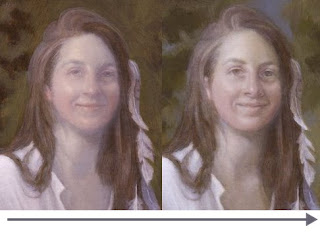
On the left side is a picture of the last completed layer (uncorrected).
On the right is the current layer (uncorrected).
That short journey from left to right is the subject of this little mini- demo on how to paint a layer on a face. (Of course, the same process works for hands, feet, all skin showing).
I use this method (multiple layers) to build light and form in small increments in order to get the luminosity of the Old Masters.
The more layers I paint - the more luminous it gets.
This example is only one of the many "middle layers" and merely illustrates a small (and relatively easy) step that goes into painting a portrait.
This particular face is small, only 3.25 inches high and this entire layer (shown) here only takes me half an hour (more or less). It is a lot easier and faster than it looks - really!
The hard part is waiting for my paint to dry so I can begin to build the next layer.
While I wait, however, I work on background, clothing, props, other paintings, this blog, run errands, eat lunch...you get the idea.

This is the corrected face from the last demo on losing/finding a likeness. It is now ready for yet another layer.

I begin by reinforcing the lights (Titanium White) and the darks (Raw Umber thinned with Liquin) to increase the contrast. I try to avoid hard edges in this.
I let this dry thoroughly (i.e., overnight).

This is the palette I use in a layer. It does not matter if the skin tone is light or dark...the colors are the same but obviously the values will be different.

I mix/match the approximate skin tone (raw umber, burnt umber, raw sienna, titanium white), mix it with Liquin and scumble it over the entire face.
Note that my paint is never so thick that I cannot see through it to the layer below.
See why I reinforced the darks & lights to bump up the contrast?

Into the wet surface, I add color. See my demo on Old Master Color Banding in Portraiture for particulars.

I blend those colors in.

This is how I mix "The Universal Color of Light."

I use this "Universal Color of Light" to build light on the face (or just about anywhere).
If the light looks chalky, I add more yellow.
If the light looks too yellow, I add more white.

I continue pulling the light down into the face. I am only working with light - not color.

I continue adding light. I locate and reinforce the centers of light with thicker paint.

I add more light, work it in and let the light build and define the form.
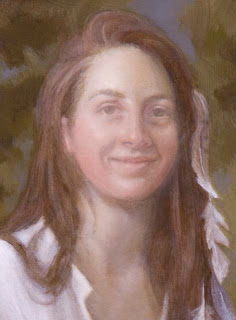
I continue to define the form with light.

I add even more light into the centers of light (as defined by the highlights).

I work this light in and build form. I allow the light to go into the hair.
This layer is done and it must be allowed to dry thoroughly.
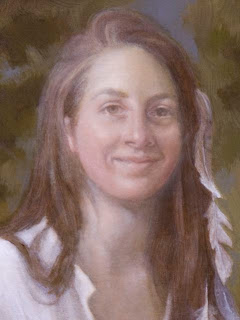
I did correct the above pix, then went on and painted the next layer below.
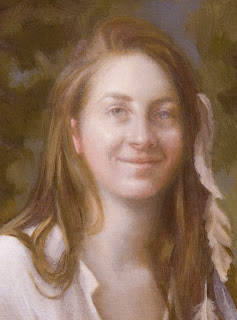
ABOVE: Here is a peek at the next layer (uncorrected as to likeness, without a skin tone glaze and ill-defined features). The light is now so thick you cannot see the weave of the canvas through it. I've started to work on the hair. I wish this photo wasn't so small - it is really quite a jump forward.
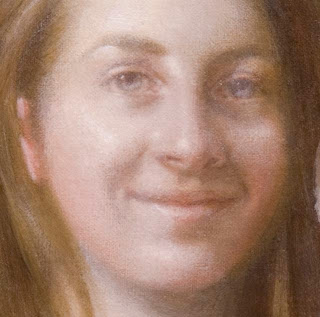
This is a detail. You can see the color locked underneath as I build light on this face.
Next:
*
I'll correct the likeness and define the features with raw umber and let it dry.
*
Next I'll glaze this back into a skin tone and let it dry.
*
Then I'll match a scumble to the skin tone and work color (bands) into the face
*
I'll let this dry - and repeat the process if necessary.
Considering how "unfinished" this stage looks right now, it is relatively quick and easy to transform a face with several layers of light into a finished face.
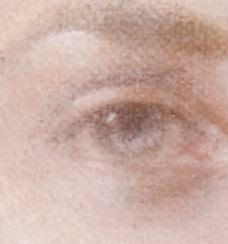
This is a detail showing how the light flows over the face with what is underneath still being visible. Do NOT paint around features like eyes, eyebrows - and don't be afraid to paint over the entire face in order to define the light. It is the paint that shows through that gives a painting its subtle beauty of form.
NOTE: I usually do the face LAST as the skin tones are really determined by what surrounds it (i.e., the background). So I'm going to stop working on the face now and bring the rest of this painting into being before I get all the color into this face.
I just keep repeating this entire layering process until the face tells me when it is time to stop and finish.
"Everything the same; everything distinct."
- Zen Proverb
Subscribe to:
Posts (Atom)